Search
Table of Contents
-
What Is Managed Detection and Response (MDR)?
- Managed Detection and Response Explained
- What MDR Includes—and What It Does Not
- How Managed Detection and Response Works
- What Telemetry Does MDR Monitor?
- Core Capabilities of MDR Services
- MDR vs. MSSP vs. EDR vs. XDR
- Primary Business and Technical Benefits of MDR
- When Should an Organization Consider MDR?
- How to Evaluate an MDR Provider
- Managed Detection and Response FAQs
- MDR vs. EDR vs. MSSPs
- Implementing MDR
- The Impact of MDR on Modern Cybersecurity Strategies
- Managed Detection and Response (MDR) FAQs
- What is the Difference Between EDR vs MDR?
- How To Evaluate MDR Solutions
-
What Are Managed Detection and Response (MDR) Services?
- Managed Detection and Response Services Explained
- The Core Components of an MDR Service Delivery Model
- How MDR Services Protect Modern IT Environments
- Key Benefits of Outsourcing to an MDR Provider
- MDR vs. MSSP vs. XDR: Key Distinctions
- Critical Questions for Evaluating Enterprise MDR Vendors
- Managed Detection and Response Services FAQs
- Best Arctic Wolf Competitors & Alternatives in 2026
What is MDR vs MSSP?
5 min. read
Table of Contents
The primary distinction between MDR (Managed Detection and Response) and MSSP (Managed Security Service Provider) lies in their roles during a cyber threat incident. An MDR provider actively neutralizes, contains, and remediates active attacks on your behalf. In contrast, a traditional MSSP primarily focuses on broad infrastructure management and sends alert notifications. Consequently, the investigation and actual threat mitigation are left to your internal IT team.
Key Points
-
Remediation ownership: MDR providers directly isolate hosts, terminate malicious processes, and neutralize active threats, whereas standard service providers only issue alerts. -
Telemetry emphasis: Sophisticated detection models utilize endpoint, cloud, and identity behavioral metrics, while traditional management services rely heavily on perimeter firewalls and centralized log collectors. -
Hunting mechanisms: Analytical operations utilize human-led, intelligence-backed threat hunting loops to uncover hidden tactics, whereas perimeter aggregators primarily operate based on static correlation rules. -
Operational scope: Security monitoring partnerships focus on engineering tasks like compliance reporting, device patching, and configuration management, rather than tactical live asset containment.
Key Differences Between MDR and MSSP
An MSSP primarily helps manage security operations and tools, while an MDR provider primarily helps find and stop attackers. Below is a summary table of the key differences.
| Area | MDR Managed Detection and Response |
MSSP Managed Security Service Provider |
|---|---|---|
| Primary objective | Detect, investigate, contain, and respond to active cyber threats | Operate and maintain an organization’s broader security environment |
| Core focus | Threat detection and incident response | Security management, monitoring, administration, and compliance support |
| Typical services | 24/7 monitoring, threat hunting, alert investigation, incident containment, and remediation guidance | Firewall management, vulnerability scanning, SIEM monitoring, endpoint management, email security, access management, and compliance reporting |
| Alert handling | Investigates alerts to determine whether they represent a genuine threat | Often monitors alerts and escalates them to the customer’s internal team |
| Response capability | Usually takes or coordinates direct action, such as isolating endpoints, disabling accounts, or blocking malicious activity | Response may be limited unless incident-response services are included in the contract |
| Threat hunting | A standard or defining capability; analysts proactively search for hidden threats | Usually not included by default or offered as an add-on |
| Technology approach | Commonly centered on EDR, XDR, SIEM, network telemetry, and behavioral analytics | Manages a wider range of security products, infrastructure, and vendor platforms |
| Human expertise | Security analysts, threat hunters, malware specialists, and incident responders | Security administrators, SOC analysts, compliance specialists, and infrastructure engineers |
| Level of proactivity | Highly proactive—looks for attacker behavior before or beyond automated alerts | Often more operational and reactive—maintains tools, monitors events, and reports issues |
| Customer responsibility | Customer involvement is reduced because the provider performs deeper investigation and may execute containment actions | Customer usually retains more responsibility for investigating and responding to escalated incidents |
| Service scope | Narrower but deeper, concentrating on detecting and stopping threats | Broader but sometimes less specialized in advanced detection and response |
| Reporting emphasis | Incident findings, attacker activity, root cause, affected assets, and response actions | Service availability, security events, device status, policy compliance, and operational metrics |
| Best suited for | Organizations lacking an internal detection-and-response team or needing stronger 24/7 incident capabilities | Organizations that need outsourced management of multiple security systems and routine security operations |
| Typical success metrics | Mean time to detect, mean time to investigate, mean time to contain, incident severity, and threat coverage | Uptime, SLA compliance, number of alerts handled, device coverage, patching status, and compliance performance |
| Relationship to the other model | May be purchased as a standalone specialist service or offered by an MSSP | May include MDR as one component of a larger managed-security portfolio |
MDR vs MSSP Explained
Enterprise security leaders evaluate outsourced security paradigms to address severe internal expertise shortages and expanding attack surfaces. The structural divide between these models stems from their underlying operational philosophies and technological foundations.
Traditional outsourcing models emerged to handle the specialized engineering tasks required for maintaining firewalls, intrusion detection networks, and implementing continuous vulnerability patching schedules.
As evasion techniques grew more sophisticated, passive device preservation and mass alert generation proved insufficient against advanced persistent threats. MDR developed to fill this critical operational gap by assuming direct responsibility for the detection of adversarial behaviors and the execution of containment protocols.
Understanding the precise demarcation line between infrastructure administration and threat mitigation ensures organizations do not expose operational vulnerabilities during live incidents.
MDR vs MSSP: Technical Differences
The primary differences between these methodologies lie in their underlying ingestion frameworks and incident management strategies. These choices dictate how rapidly an external team can identify an adversary and stop lateral movement.
Telemetry Collection and Analysis
Managed detection frameworks leverage deeper contextual data points collected from hosts, cloud containers, and authentication systems. These solutions utilize advanced endpoint platforms to capture volatile memory states, registry modifications, and process execution trees.
Traditional management architectures rely on log shipping protocols to aggregate volume-heavy syslog events into a central repository. This method often results in significant notification delays because parsing engines must clean, normalize, and correlate diverse network formats before generating an actionable alert.
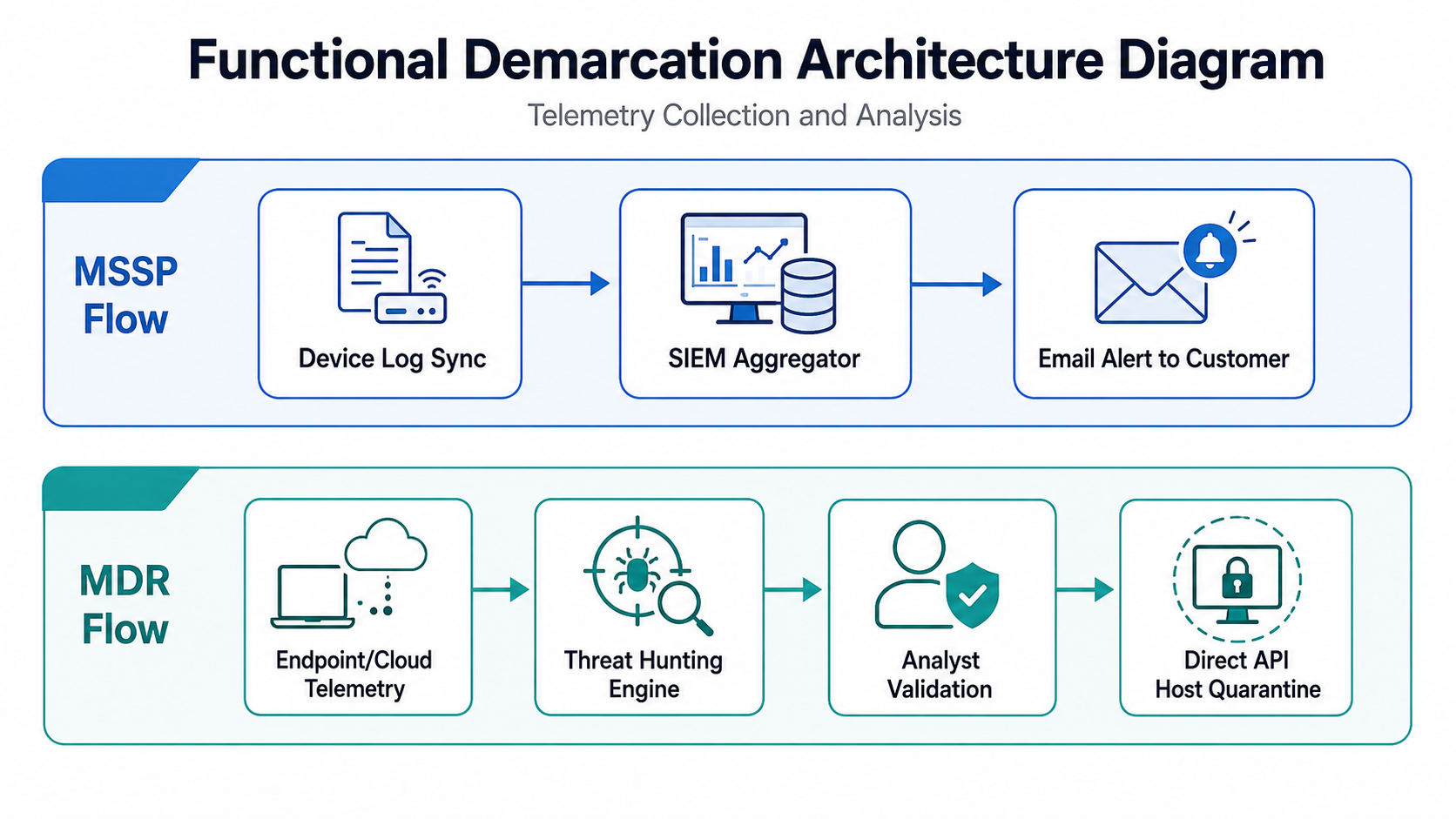
Incident Response and Mitigation Ownership
The operational boundary is defined by who executes containment commands during an ongoing attack. Detection teams operate with explicit authority to modify access controls, quarantine assets, and deploy mitigation scripts directly into an environment.
Perimeter administrators flag anomalous events and pass the remediation responsibility back to internal enterprise stakeholders. This approach creates an operational handoff delay that can allow attackers to establish persistence or execute encryption routines before internal teams can intervene.
Operational Benefits of MDR
Deploying a modern threat mitigation framework shifts the security posture from a defensive, compliance-oriented state into an active defensive posture. This transformation lowers technical risk by compressing the time an adversary can remain undetected within an environment.
Continuous Proactive Threat Hunting
Specialized analysts perform iterative searches through historical telemetry to find subtle indicators of compromise that slip past traditional filtering tools. These investigations rely on real-time global intelligence pipelines to trace emerging techniques and identify advanced persistent actors.
Passive correlation models miss these complex paths because they screen exclusively for known file hashes or simplistic threshold exceptions. Proactive hunting exposes living-off-the-land techniques where malicious actors manipulate legitimate system tools.
Automated and Analyst-Led Remediations
Modern response mechanisms incorporate orchestrations that isolate compromised devices within moments of verification. This rapid isolation stops lateral movement across sensitive organizational boundaries and protects adjacent server environments.
[Threat Identified] -> [Automated Isolation Script] -> [Host Quarantined via API] -> [Analyst Neutralization]Human validation ensures complex response actions do not inadvertently disrupt critical business operations or crash live production databases. This blend of machine speed and human oversight minimizes total business disruption during an incident.
Operational Benefits of MSSPs
While reactive architectures may struggle with advanced threat containment, they provide foundational value for day-to-day network operations and infrastructure maintenance. These providers streamline security hygiene tasks across disparate networks.
Perimeter Device Management and Configuration
Maintaining appropriate patch levels and complex rule structures across global firewall arrays requires significant administrative overhead. Security service providers manage these recurring configuration cycles, system backups, and policy updates efficiently.
This systematic device management prevents threat actors from exploiting unpatched firmware vulnerabilities or exposed interface configurations. Outsourcing these tasks frees up internal technical teams to focus on core corporate business priorities.
Regulatory Compliance Visibility and Log Aggregation
Many governance frameworks require strict log retention periods, detailed audit trails, and comprehensive asset reports. Centralized data aggregators generate these audit-ready dashboards across multi-cloud environments automatically.
[Network Syslog Data] -> [MSSP Aggregator Engine] -> [Normalized Data Store] -> [Compliance Report Generation]These automated collection services ensure compliance with strict industry standards like PCI-DSS, HIPAA, and SOC 2. However, these dashboards focus primarily on historical compliance reporting rather than real-time threat neutralization.
Key Selection Factors for Enterprise Security Leaders
Choosing an outsourced framework requires evaluating your existing internal security operations center maturity, your existing technology stack, and your target risk profile. Organizations must balance operational speed against administrative management priorities.
| Selection Metric | Managed Detection and Response (MDR) | Managed Security Service Provider (MSSP) |
|---|---|---|
| Primary Objective | Root-cause threat eradication and containment | Infrastructure management and compliance metrics |
| Telemetry Ingestion | Endpoint behavioral telemetry, cloud API metrics, and identity data | Network firewall logs, intrusion detection alerts, and system syslogs |
| Response Capability | Active endpoint isolation, session termination, and file removal | Passive incident forwarding, basic alerting, and threshold adjustments |
| Technology Stack | Provider-managed analytics platforms and advanced endpoint software | Enterprise-owned security information and event management arrays |
| Analyst Engagement | Deep forensic investigation, incident triage, and human threat hunting | High-volume alert validation, health monitoring, and tier-1 routing |
| Compliance Value | Validation of real-time threat detection and mitigation efficacy | Audit-ready historical report generation and log retention archives |
Challenges of Outsourced Security Frameworks
Outsourcing security functions can introduce operational complexity if team communication workflows are poorly integrated. Relying entirely on automated alerts from third-party ecosystems can result in significant context fragmentation.
Internal engineering teams must invest ongoing effort to document operational contexts, update asset charts, and clarify communication workflows. Without this contextual tuning, external providers may misinterpret standard system behaviors and trigger repetitive false alarms.
Furthermore, integrating disparate toolsets across hybrid cloud landscapes can obscure visibility gaps if the primary telemetry pipes are not maintained. These visibility blind spots can leave organizations vulnerable to targeted credential misuse and unmonitored lateral movement.
MDR vs MSSP FAQs
Organizations often use a hybrid approach that leverages both service models concurrently. The service provider handles baseline infrastructure maintenance, device patching, and historical compliance reporting, while the detection team owns high-fidelity threat monitoring and live endpoint incident containment.
An MDR service does not automatically replace a security information and event management platform. Many advanced detection frameworks ingest data directly from endpoints, cloud identities, and networks without needing a standalone repository, though large enterprises often maintain a central repository to store non-security data and long-term logs.
Detection providers typically offer significantly faster threat containment times because their teams use integrated response tools to isolate hosts and kill malicious processes directly. Traditional service providers rely on ticketing models that pass alerts to internal staff, introducing a handoff delay before remediation begins.
Service providers concentrate heavily on generating compliance documentation, managing audit logs, and maintaining perimeter firewall rules required by regulatory frameworks. Detection providers prioritize active risk mitigation and threat elimination, which fulfills different compliance needs focused on operational resilience.
Organizations suffering from acute engineering shortages usually see faster risk reduction by deploying a detection and response service. This option provides the deep analytical expertise and continuous human monitoring needed to stop live threats without requiring the internal team to manage alert triage.


